

A rig for putting time-base correctors (TBCs) used with VHS and Betamax through their paces. An ESP32 generates NTSC composite video with precisely controlled faults. The signal passes through the TBC under test, and a scope (an ADP2230 here) captures what came out and, optionally, what went in. The tools then report how well the TBC repaired it, and grade it (provisionally).
⚠ Use at your own risk. TBT is a torture test: it deliberately feeds a TBC broken, out-of-spec signals. We've run it on our own TBCs without damaging them, but we can't promise the same for yours. See Disclaimer before connecting equipment you care about.
A field trial is one run of the suite against a TBC: a series of test rungs, each captured and analysed, rolled up into one report. The name works twice over, since many of the tests drop, cut or snow fields.

What each test does, in plain words and with every rung, is in docs/tests.md. The test catalog, scoring and grader contract are in docs/design.md. Measured hardware and toolchain facts (settling times, quirks, pitfalls) are in docs/bench-notes.md. Read it before changing the tools. Open work is in TODO.md.
| Area | State | Details |
|---|---|---|
| Colour bars, first light | Done | SMPTE and EIA bars, staircase, flat, crosshatch. Hue within 1.5° and luma within 0.5 IRE at the DAC |
| Timing tests (H1–H5, F1–F3) | Done | Verified against the reference model. F1 not yet measured on the scope |
| Structure tests (S1–S9) | Done | Verified, and observed through two TBCs. S4, S8 and S9 target frame synchronisers |
| Colour and level tests (C1–C4, L1–L4) | Done | Verified, with picture metrics (burst, hue, saturation, level, noise, hum) |
| Fault tests (S10, S11, X1, V1) | Done | Lost-field tolerance, a stress-and-recovery fault hunt for buggy units, and a no-signal capture of the TBC's own fallback output |
| Colour-under (VHS/Betamax) | Default | Direct colour (U-matic/1") available with chroma follows |
| Frame marker, manifest, capture runner | Done | The marker decodes through the TBC on CH1 and on the CH2 reference |
| Device tagging and reports | Done | --dut/--note on every run; optional --html report |
| CH2 reference | Done | Every two-channel run checks its input, and measures the TBC's latency, whether its output is locked to the input, and its gain against the real input |
| One-channel rigs | Supported | --channels 1 needs only CH1 (one scope channel, no tee) |
| Grader | Provisional | tools/grade.py (or run_suite.py --grade) grades every run, each test and the whole field trial. Thresholds not yet checked against a known-good TBC |
| Fingerprinting | Done | tools/fingerprint.py builds a fingerprint from several field trials; fingerprints/ holds the library (TBC-1000 so far) |
| Identification | Planned | Matching an unknown TBC against the fingerprint library |
| Rig calibration | In progress | CH2 wired; generator levels and chroma roll-off still to calibrate, CH1 to terminate |
Open work is in TODO.md.

| From | To | Notes |
|---|---|---|
| ESP32 GPIO25 (DAC1) | 75 Ω series resistor → BNC centre | Source resistor; matches the cable, does not terminate it |
| ESP32 GND | BNC shield | |
| BNC tee (run 1) | TBC input | The TBC's 75 Ω input terminates run 1 |
| BNC tee (branch) | ADP2230 CH2 | Short coax, no terminator; the scope's 1 MΩ input only listens |
| TBC output (run 2) | monitor → vectorscope (loop-through, 75 Ω off) | |
| End of run 2 | BNC tee + 75 Ω terminator → ADP2230 CH1 | The one termination for run 2 |
| ESP32 USB, ADP2230 USB | Mac | Power, serial control, capture |
Every coax run needs exactly one 75 Ω termination at its far end. The ESP32's DAC can push its output up but barely pull it down, so an open-ended run turns the 3.58 MHz chroma into a sawtooth (about 4× too small) and the picture goes dark and rolls.
The default levels (levels 0 73) still need calibrating. The target is
286 mV of sync and 714 mV of white above blanking. Measured on CH2 into the
TBC's 75 Ω input: 226 mV of sync (79 %), with chroma and burst about 0.68× of
nominal at 3.58 MHz.
Not everyone has a two-channel scope or spare tees. With --channels 1 (or
TBC_CHANNELS=1) the tools capture CH1 only:
| From | To |
|---|---|
| ESP32 GPIO25 → 75 Ω series resistor → BNC | TBC input (its 75 Ω input terminates the run) |
| TBC output | scope CH1, with a 75 Ω terminator (a tee, or a monitor's loop-through with termination on) |
Everything still works: every output field is classified, the frame markers are decoded, and lost-field tolerance, the fault hunt and the dropout watch run as usual. A single-channel run can't check its own input, can't measure the TBC's latency, and judges picture levels against nominal values rather than the generator's real output. Reports label those runs "CH1 only". The dropout watch only ever uses CH1.
With two channels, a run whose CH2 shows no video says so ("is the reference connected?") and is otherwise reported as single-channel.
You need an original ("classic") ESP32, the chip on most ESP32-WROOM-32
and ESP32-DevKitC boards. esptool chip-id reports it as ESP32-D0WD…
(or ESP32-D0WDQ6… on older boards). The firmware builds for PlatformIO's esp32dev
board. Cheap ESP32 dev boards usually have this chip, but check: the newer
family members won't work.
| Chip | Works? | Why |
|---|---|---|
| ESP32 (classic: D0WD, D0WDQ6, PICO-D4, WROOM-32, WROVER) | Yes | 8-bit DACs on GPIO25/26, and I2S0 can stream DMA straight into the DAC ("built-in DAC mode"), clocked from the audio PLL |
| ESP32-S2 | No (not without a port) | Has DACs, but not the I2S-to-DAC path this firmware uses |
| ESP32-S3, C3, C5, C6, H2, P4 | No | No DAC at all |
Why it's special. A composite video signal needs about 14.3 million samples a second, every one on time, for as long as the test runs. No CPU can write a DAC that fast by hand, so the samples have to stream by DMA. The classic ESP32 has a rare combination:
- DMA straight into its own DAC. I2S0 in "LCD/DAC mode" feeds the 8-bit DAC directly, with no external parts.
- A tunable audio PLL (APLL), which sets the sample clock to exactly 4 × the colour subcarrier (14.318182 MHz) and can trim it in ~2 ppm steps. An exact subcarrier is what makes the colours right.
- Linked-list DMA descriptors with their own lengths. Each line plays from a buffer through its own descriptor. Changing a descriptor's length moves the next line's sync, which is how TBT creates timing faults without re-rendering anything.
- Enough RAM for two frames of DMA descriptors and a pool of pre-rendered lines (each line is 1,820 bytes). With everything allocated, about 189 KB of heap is left. A second core rewrites one frame while the other plays.
Porting to something else. The host tools don't care what makes the
signal. They talk to the generator over serial (test, manifest, info;
see Serial commands) and read the frame
markers from the video. Another microcontroller would need:
- A continuous sample stream of at least 14.3 MS/s with no CPU in the loop. Either a DAC fed by DMA (check its conversion rate: many on-chip DACs top out at a few MS/s), or a parallel port driving an external resistor-ladder (R-2R) or video DAC. The RP2040/RP2350's PIO plus DMA into a resistor ladder is a well-trodden route for composite video.
- A sample clock at exactly 4 × fsc (14.318182 MHz), or a known multiple, ideally trimmable in ppm. A fractional PLL does this, or so does an external 14.318 MHz crystal, a standard NTSC part.
- Scatter-gather DMA: a chain of descriptors, each pointing at a line buffer with its own length, that the CPU can rewrite while it plays. Variable lengths are what make the timing tests (H, F, S) possible.
- At least 8 bits of resolution. That is the DAC's noise floor: 8 bits gives about 0.55 IRE rms, roughly 45 dB, which limits L2. 10 bits or more would be better.
- An output stage into 75 Ω: about 1 V p-p into a terminated line, through a 75 Ω source resistor (see Wiring).
The firmware's test logic (src/perturb.cpp, mirrored in
tools/perturb_model.py) and the frame marker are plain C++ and would carry
over. The parts that are ESP32-specific are the DMA ring and the clock
(src/i2s_dac.*, src/ntsc_gen.*).
- Signal path. The classic ESP32 (D0WD) runs I2S0 in LCD/DAC mode and streams DMA straight to its 8-bit DAC on GPIO25 at 4 × fsc = 14.318182 MHz, clocked from the APLL.
- Two-frame DMA ring. The ring has two halves, one frame each. An end-of-frame interrupt wakes a task that rewrites the half that just finished while the other plays (6–9 ms of a 33 ms frame). Sequences never repeat, and a half can hold any number of lines (up to 600), so frames can drop fields or change line count.
- Pre-rendered lines. Each distinct line is rendered once from a model (sync, burst, Y/U/V segments with band-limited edges) in up to 8 sub-sample shifted copies.
- Timing faults live in the ring, not the picture. A descriptor's length sets where the next line's sync falls, in 2-sample (140 ns) steps; the shifted copies fill in the fine steps (35 ns with 4 copies).
- Colour-under by default. Sync, luma and the colour envelopes jitter while the 3.58 MHz carrier stays on a continuous reference, as a VHS/Betamax deck delivers it.
- Reproducible. Every perturbation is a pure function of the absolute line
number (
src/perturb.cpp, mirrored bytools/perturb_model.py), so the grader can rebuild exactly what was sent from the manifest. - Frame marker on lines 24 and 287, the top picture rows. TBCs commonly blank the vertical interval, and the TBC under test blanks lines 10–21. The marker is 36 cells of 1.4 µs encoding test code, rung, a 16-bit frame counter and a CRC-4.
- Standards. Timing follows SMPTE 170M: 4.7 µs H-sync, 2.3 µs equalizing pulses, serrated broad pulses, 9-cycle burst at 5.3 µs, 7.5 IRE setup, interlace half-lines at 263/283.
A summary is below. docs/tests.md explains each test in plain words (what it imitates, what a good TBC should do) and lists every rung. Each test is tagged with the TBC class it targets. Its manifest states the ideal output for a line TBC (corrects timing, passes structure through) and for a frame TBC / synchroniser (outputs standard fields whatever comes in). That way a line TBC isn't marked down for passing a dropped field through.
| ID | Test | Aimed at | Rungs (mild → severe) |
|---|---|---|---|
| V0 | clean baseline | both | 1 |
| H1 | random line jitter, rms ns | both | 5, 10, 20, 50, 100, 200 |
| H2 | sinusoidal jitter, peak ns @ Hz | both | 50@1 … 2000@30 |
| H3 | timing step, µs, toggles every 0.5 s | both | 0.25, 0.5, 1, 2, 5 |
| H4 | head-switch skew, µs (lines 520–256) | both | 0.5, 1, 2, 5, 10 |
| H5 | displaced single line (100 and 362), samples | both | +2, −2, +4, −4, +10, −10, +20, −20 (8 rungs) |
| F1 | sample-clock offset, ppm | both | +10, −10, +30, −30 … +1000, −1000 (10 rungs) |
| S3 | missing H syncs from line 100, lines | both | 1, 2, 5, 10, 20 |
| S4 | malformed vertical interval, variant | frame | 1 EQ pulses → H sync · 2 unserrated V-sync · 3 both · 4/5 V-sync missing in field 1 every 30/6 frames · 6 V-sync missing in every field |
| S5 | progressive 240p (two 262-line fields per frame) | frame | 1 |
| S6 | lines removed/repeated per field at lines 200 and 462 | frame | −1, +1, −3, +3, −10, +10 |
| S7 | dropped field: every N frames field 2 is missing | frame | 60, 30, 15, 6, 2 |
| S8 | field-length wow: lines added/removed per field, peak @ Hz | frame | 1@0.5, 2@1, 5@1, 10@2, 20@2 |
| S9 | search noise bar: a band of sync-less snow moving 23 lines a frame, lines | both | 2, 5, 10, 20, 40 |
| S1 | sync amplitude, IRE (40 nominal) | both | 30, 25, 20, 15, 10 |
| S2 | slow sync edges, 10–90 % rise, ns | both | 250, 500, 1000 |
| F2 | H rate against a fixed subcarrier, ppm (SCH drifts) | both | +10, −10, +50, −50 … +1000, −1000 (8 rungs) |
| F3 | slow H-rate drift, peak ppm over a 10 s period | both | 50, 300, 1000 |
| C1 | burst amplitude, IRE p-p (40 nominal) | both | 30, 20, 10, 60 |
| C2 | no burst | both | 1 |
| C3 | burst + chroma phase jitter, line to line, rms degrees | both | 2, 5, 10, 20 |
| C4 | picture hue offset against burst, degrees | both | 5, 10, 20, 45 |
| L1 | dropouts (snow over part of a line), µs × per field | both | 2×1, 5×2, 10×5, 20×5, 50×10 |
| L2 | additive noise, SNR dB (100 IRE / rms) | both | 40, 34, 28, 22, 16 |
| L3 | 60 Hz hum, IRE p-p | both | 5, 10, 20, 40 |
| L4 | video level, % | both | 80, 90, 110, 120 |
| S10 | N consecutive fields of no signal (0 V), once a second | both | 1 … 11 (11 = "∞, more than 10") |
| S11 | N consecutive fields of snow, once a second | both | 1 … 11 |
| V1 | no signal at all, to capture the TBC's own fallback output | both | 1 |
| X1 | fault hunt: 3 s cycle of 1 s clean, 1 s stress, 1 s clean | both | stress 1 jitter 200 ns · 2 dropped fields · 3 lost fields · 4 noise bar + jitter · 5 "bad tape" mix |
C3, L2 and L3 reuse each line's pre-rendered copies (normally sub-sample
timing shifts) as phase, noise or DC versions. The resolution is therefore
subsample_steps levels (4 for SMPTE bars), and the manifest records the
value of each. F2 and F3 are done in the timing model, not by retuning the
clock. The 8-bit DAC's own quantization noise is about 0.55 IRE rms (~45 dB),
the floor for L2.
A dropped field leaves a lone half-line. It plays as 456 samples rather than 455, because the DAC consumes samples in pairs (+35 ns at the drop).
Build and flash with PlatformIO's own Python. Homebrew's pio runs on
Python 3.14, which the platform rejects. The serial port moves between USB
sockets, so look it up:
~/.platformio/penv/bin/pio run -t upload --upload-port $(ls /dev/cu.wchusbserial* | head -1)
The host tools need numpy and pyserial.
export TBC_DUT="AVT-8710"                         # name the device under test once per session
export TBC_NOTE="composite in/out, controls at default"
export TBC_CHANNELS=1                             # only if your rig has CH1 alone (see "Minimal rig")
python3 tools/run_suite.py                      # a field trial: one rung of every test (~3 s each)
python3 tools/run_suite.py --html               # ...plus an HTML report in reports/
python3 tools/run_suite.py H1:all S7:4-5        # chosen tests and rungs on one scope session
python3 tools/run_test.py H1 4                  # a single rung
python3 tools/run_test.py H1 4 --keep           # ...and keep its capture for debugging
python3 tools/observe_tbc.py runs/<run>         # what the TBC passed, dropped or repeated
python3 tools/verify_timing.py                  # check the firmware against the reference model (~25 s)
python3 tools/check_lines.py                    # check colour bars as rendered
Every run prints observe_tbc's report on the TBC output. With two channels
it adds the input check from CH2, the latency, the output's line rate against
the input (0 ppm means locked; otherwise latency drifts and the TBC drops or
repeats a frame when it wraps), and burst, chroma, gray and hue against the
real input. Every run also records the
device under test (--dut, or $TBC_DUT) and its settings (--note, or
$TBC_NOTE) in the manifest, and stops with an error if the generator isn't
advancing frames. --html (off by default) also writes a self-contained
report to reports/<time>_<dut>.html. It contains a summary table and, for
each run, the ideal output per TBC class, key figures, a frame-sequence strip
and one captured line. reports/ is not committed. The capture is
then deleted by default. With --keep (on run_test.py or
run_suite.py), the run stays in runs/<timestamp>_<test>_r<rung>/ as
manifest.json plus capture.npz (raw int16 per channel captured,
volts = raw × scale + offset). A run whose report fails is always kept. Kept
runs are large, 50 MB per channel per 0.5 s at 50 MS/s, and runs/ is not
committed. Where the time goes is broken down in
docs/bench-notes.md.
For photos and posts, the generator can show a TBT title card: TBT in large letters, TIME BASE TORTURE and MEDIA ARCHIVE PROJECT beneath, and a slim strip of colour bars. It is never part of a test.
python3 tools/run_suite.py --title --html          # 5 s of title card, then the field trial
python3 tools/run_test.py V0 --title 10             # 10 s of title card before one rung
python3 tools/gen_cmd.py "p title"                  # leave it up (until the next run)
Nothing is captured while it shows. Every run also switches the generator back to the test pattern before testing, so a title card left up never ends up in the results.
docs/sample-report.html is a full --html report
of a field trial: 56 runs on a warmed-up green AVT-8710, covering one rung of every test, every
rung of S10/S11, all five X1 stresses and V1. GitHub shows HTML files as
source, so download it and open it in a browser. The page is self-contained.
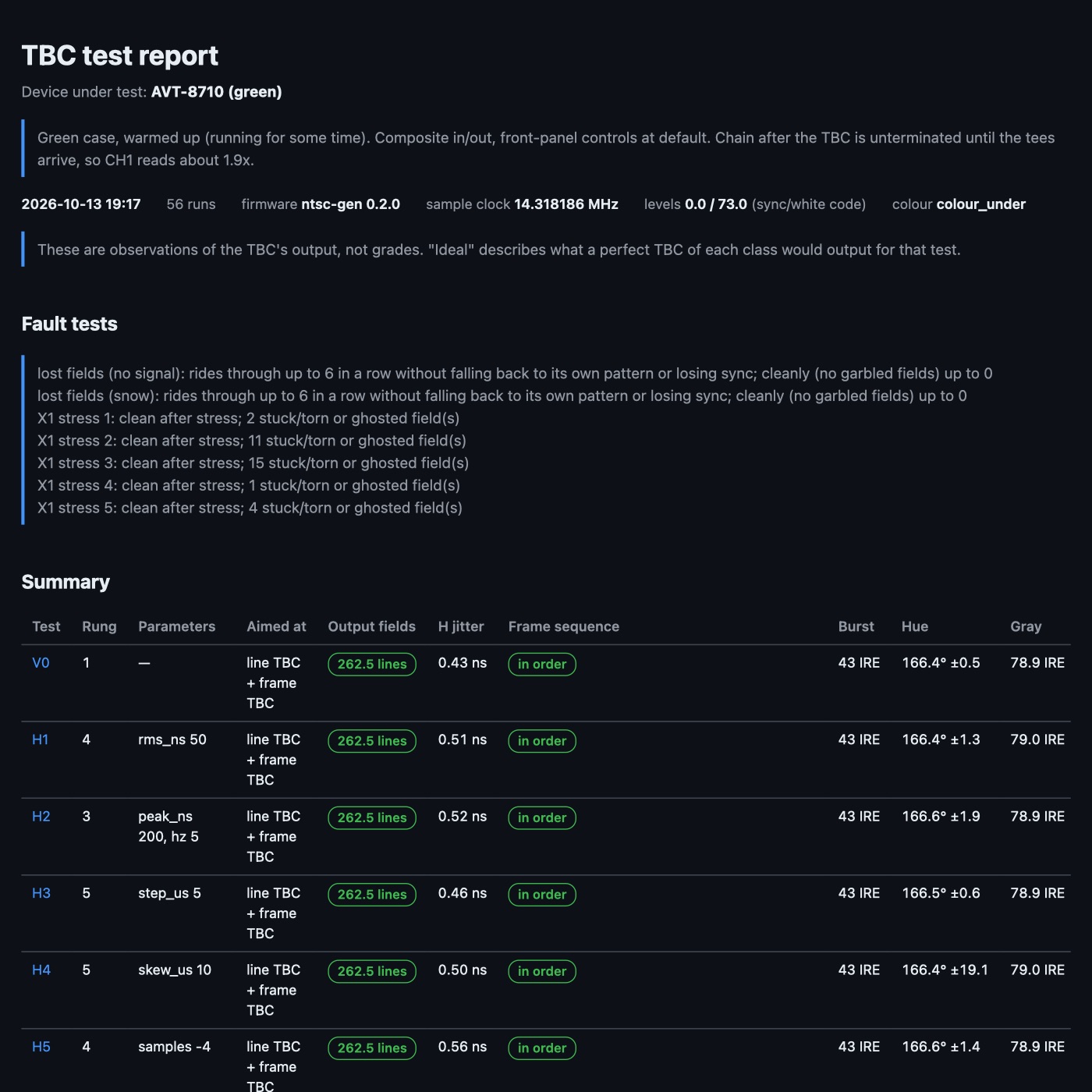
It was made with:
python3 tools/run_suite.py V0:1 H1:4 H2:3 H3:5 H4:5 H5:4 F1:3 F2:5 F3:2 S1:5 S2:3 S3:5 S4:3 S4:6 S5:1 \
    S6:5 S6:6 S7:4 S8:5 S9:4 C1:3 C2:1 C3:3 C4:3 L1:4 L2:3 L3:3 L4:4 S10:all S11:all X1:all V1:1 \
    --dut "AVT-8710 (green)" --note "..." --seconds 0.4 --html
Every output field is classified by what it carried:
| Class | Meaning |
|---|---|
| ours | carries our frame marker (frame number known) |
| ours, unmarked | our picture, but the marker line was lost (e.g. a gap ended mid-field) |
| blended (ghosted) | our marker with cells at in-between levels: two frames mixed |
| blank | black/blank field |
| garbled | picture that matches neither ours nor a uniform pattern (seen while a TBC re-acquires) |
| TBC's own pattern | a uniform full-field picture that isn't ours, e.g. the AVT-8710's fallback bars |
Picture measurements only use fields carrying our marker, so a TBC that gives up and shows its own bars can never pass as our signal. V1 checks this: with no input, the AVT-8710's bars measure a yellow hue indistinguishable from ours, but every field classifies as "TBC's own pattern" and nothing is measured.
- S10/S11 report, per rung, whether the TBC rode through N lost fields (no fallback, no sync loss) and how: held the last frame, blanked, or garbled on recovery. A suite across all rungs gives the tolerance: the largest N handled, or "∞ (>10)".
- X1 splits the output by input frame into before / stress / settling (first 3 frames after stress) / after. It counts fields that aren't ours, ghosted fields, stuck/torn frames (fields from different frames), back-steps and repeats. A unit that stays faulty after the stress ("ghost mode") shows up in the "after" window.
Slow tests capture longer automatically: S10/S11 1.3 s at 25 MS/s, X1 3.3 s at 12.5 MS/s.
--grade on run_suite.py grades the field trial as it finishes, and adds
the grades to the HTML report (with --html):
- a verdict per run (pass, marginal, fail, invalid, info) with every check listed;
- a grade per test (the highest rung passed);
- an overall score out of 100.
tools/grade.py re-grades a saved trial without recapturing, for example
after a threshold change:
python3 tools/run_suite.py --grade --html                    # grade a field trial as it runs
python3 tools/grade.py reports/<time>_suite_<dut>.json --html  # re-grade a saved one
python3 tools/grade.py reports/<time>_suite_<dut>.json --class line   # line-TBC ideals for S5-S8
The checks and thresholds are in docs/design.md. They are first proposals, so treat grades as provisional until they've been checked against a known-good TBC. With CH2, picture figures are judged against the real input; with one channel, against nominal levels. The residual horizontal displacement is judged as the excess over the trial's V0 run, which sets the measurement floor. So include V0 in every graded trial (the default set does).
A fingerprint describes how a TBC behaves, built from several field trials of one unit:
python3 tools/fingerprint.py reports/<t1>_suite_<dut>.json reports/<t2>_suite_<dut>.json ... --save --html
Its traits come in three kinds:
- Model traits are behaviours that should hold for every unit of a model. Examples: whether the output locks to its input or free-runs; what it shows with no signal; how many lost fields it rides through; colour killer; ACC; whether it corrects random line jitter, head-switch skew or slow timing; what it does with 240p, with no V-sync, with hum, and with level changes.
- Unit traits are measurements that may differ between units of one model: clock offset against the input, latency range, luma gain, saturation, hue offset, output burst, jitter floor, noise.
- Rig-dependent figures, such as output level in volts, are recorded but won't be used to match.
Each trait records how many trials agreed. Tests whose verdict varies between trials are listed as rates ("S8 r5 failed in 4 of 6"), because a single verdict would be misleading. Use 3 or more two-channel trials of the same unit.
--save writes fingerprints/<name>.json. That folder is committed: it is
the library that identification will match unknown TBCs against.
--html writes a readable trait card to reports/.
The first fingerprint, fingerprints/datavideo-tbc-1000.json, comes from 6
field trials:
- free-running output (+22.1 ppm);
- black with no input;
- rides through ∞ lost fields, blanking the gap;
- has a colour killer and partial ACC;
- doesn't correct random line jitter, head-switch skew or chroma phase, but does correct slow timing errors;
- converts 240p to standard fields;
- luma gain ×0.63.
Every field trial (run_suite.py run) also saves its results to
reports/<time>_suite_<dut>.json. tools/compare_suites.py lines several of
them up test by test, which is useful for repeat runs on one TBC or for
comparing TBCs:
python3 tools/compare_suites.py reports/*_suite_datavideo-tbc-1000.json --html reports/compare.html
It reports the lost-field tolerance, output sync depth and (with two channels) latency range of each suite, every dead-output episode (which test it started on, the test before it, how long it lasted, and where it recovered), and the tests whose verdict differs between suites.
tools/dropout_watch.py checks whether a TBC's output goes dead: no video
sync at all, as the Datavideo TBC-1000 did twice for about a minute after
input-loss tests. It runs three phases:
- clean V0 (the control);
- a stimulus that repeatedly cuts the input (default
S11:2, two fields of snow every second); - clean V0 again.
Once a second it captures 50 ms of CH1 and classifies the output as our picture, video without our marker (black, or the TBC's own pattern), or dead. Consecutive dead samples form an episode. The report gives each episode's start, phase and length, and the share of dead samples per phase.
python3 tools/dropout_watch.py --dut "Datavideo TBC-1000" --html            # 60 + 180 + 60 s
python3 tools/dropout_watch.py --stimulus S10:3 --stress 600 --html          # longer, no-signal gaps
Results go to reports/<time>_dropout_<dut>.json, plus .html with --html
(timeline, episode table, per-phase breakdown). Suite reports also flag any
run where the TBC's output was dead ("output dead"), and tolerance figures
skip those runs.
| Command | |
|---|---|
tests |
list the test catalog and each test's ladder |
test <id> [rung] [seed] [start_frame] |
start a test; test V0 is the clean baseline. start_frame begins at a given frame (e.g. inside a loss or stress window) |
chroma [under|follows] |
colour-under (default, VHS/Betamax) or direct colour |
manifest |
the current run's manifest, one JSON line |
list / p <n|name> |
list or select pattern: smpte_bars, eia_bars_75, staircase, flat, crosshatch, black, title (the title card) |
flat <ire> |
flat field at the given IRE level |
levels <sync> <white> |
DAC codes for −40 and 100 IRE |
ppm <x> |
trim the sample clock (1.8 ppm steps), e.g. to correct crystal error |
info |
current state as JSON |
hold <1|0> |
freeze or unfreeze the ring; prints the frame in each half |
pdump <frame> [line] [n] |
planned shift per line: target ns, e, v, played ns |
lens <half> |
played length of each line in ring half 0 or 1 |
dump <i> |
DAC codes of ring line i (half 0 from 0, half 1 from 600) |
diag, dc [code], gpio <0|1> |
DMA progress, constant DAC output, digital wiring test |
These are observations of a green AVT-8710 from CH1 alone, made before CH2 was wired, not grades. The Datavideo TBC-1000's are in docs/bench-notes.md.
| Test | What came out of the TBC |
|---|---|
| V0, S3 (20 missing syncs), S5 (240p), H3 (5 µs steps) | Every field passed once, in order |
| H4 (10 µs head-switch skew) | Fully corrected; marker at 0.0 µs offset |
| S6 −10 lines per field | Drops a field now and then to keep up |
| S6 +10 lines per field | Repeats a Scan report · 2026-10-15
From the balcony · 2 of 4 clapped
Princess and Cap'm Slop read it and passed. Their reasons are on the balcony, with every other verdict. Critics are accounts on this site with no GitHub account behind them. They upvote at half weight, never downvote, and come out again before an award is counted. Who they are. report this listing— log in to report |
0 comments
log in to comment.