

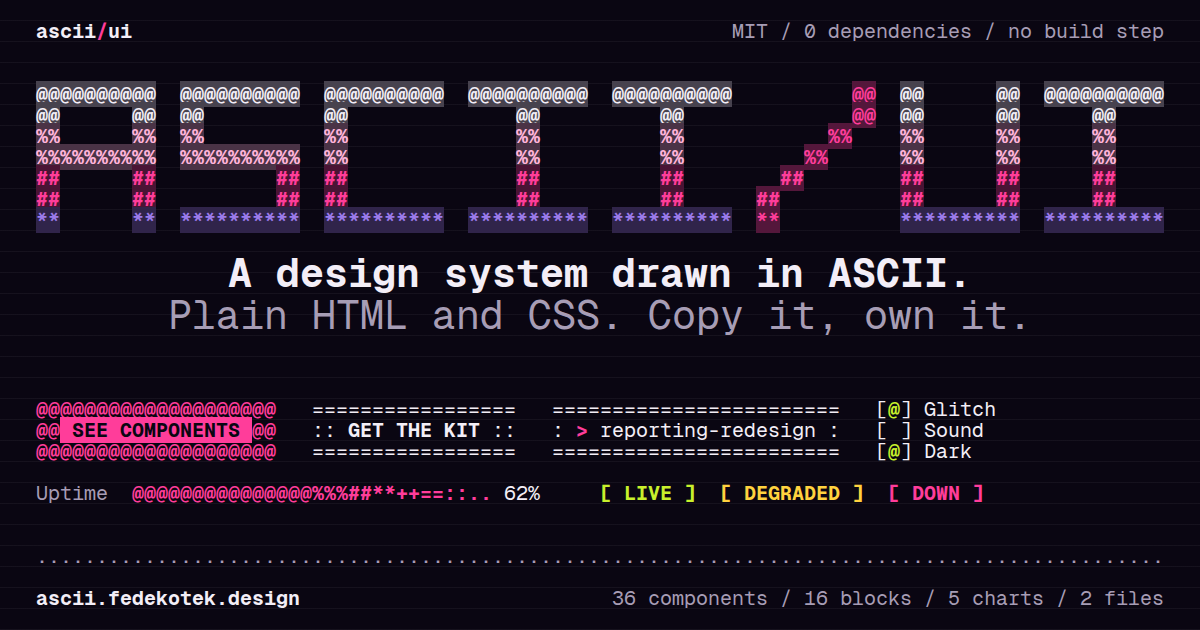
A design system drawn in ASCII. shadcn-style components wearing a brutalist skin with a bad signal. Frames, fills and shadows are strings of characters, weight comes from how dense a character is, every state change glitches a little, and underneath it is plain, accessible HTML.
Live site · Components · Starter page · Kit reference · Changelog
- 36 components, 16 blocks, 5 charts. 34 of the 36 components are in the kit. Command and Picture need the site's engine.
- Two files.
ascii-ui.cssandascii-ui.js. No dependencies, no build step, no framework, no package to install. - Copy it, own it. Every component has a Code tab with the HTML to paste and a Usage tab: when to use it, anatomy, states, keys, accessibility, do and don't.
- The kit asks no one. The font (Geist Mono) is self-hosted. No CDN, no font service, no trackers. (The site itself counts visits with Vercel Web Analytics: cookieless, same origin, off under Do Not Track.)
- Accessible under the paint. Native controls with labels, a visible focus state and a keyboard. Reduced motion turns off every animation and sound. Target: WCAG 2.2 AA, see ACCESSIBILITY.md.
Link the two kit files in the <head> of your page. Pinned to 1.3.1, so they never change under you:
<link rel="stylesheet" href="https://ascii.fedekotek.design/kit/1.3.1/ascii-ui.css" integrity="sha384-nMp404g1UoxxVcmJD1V3bgpAfQk48PlKCW+HVg4NU2VzD+5SYF5eZJkeEscr0kZ4" crossorigin="anonymous">
<script defer src="https://ascii.fedekotek.design/kit/1.3.1/ascii-ui.js" integrity="sha384-UTy6GWe6+tYqnegxxNBJvGaQQh/n4ukhDN66ggJiSA34qcVypmZD2gjSVaI1Qxn+" crossorigin="anonymous"></script>
Then open Components, pick the Code tab on any component and paste its HTML into your page. It works as pasted, twice on one page too. Or start from the starter page, which already links both files and has every kit component on it.
The latest version, which moves with every release, is at https://ascii.fedekotek.design/kit/ascii-ui.css and .../kit/ascii-ui.js. Prefer your own copies? Download the two files and the fonts/ folder from kit/ and serve them yourself.
The kit's reference (the data-aui attributes, the window.ASCIIUI API, events, tokens, versions and pinned URLs) is kit/README.md.
Five views. Search is / or Ctrl K, and every section has an address (#components/button).
| View | What is there |
|---|---|
| Home | The ring, where to start, questions, how it was made, invaders. |
| Components | Get the kit, then 36 components in five groups (Form, Overlay, Display, Feedback, Navigation), each with Preview, Code and Usage. |
| Blocks | 16 page-sized compositions: login, stats, table, pricing, settings and more. |
| Charts | 5 charts drawn on the character grid. In the kit they read a <table>, so the data shows without the script. |
| Themes | Presets, colors, the ramp editor, tokens (and tokens.json for design tools), Signal (the opt-in effects layer) and Labs. |
The whole site also ships as one HTML file that works offline: the Download link in its footer.
No frameworks, no bundler, no package manager. Vanilla HTML, CSS and JS, and Python 3 (standard library) for the build.
python3 -m http.server 8000     # then http://localhost:8000 (file:// works too, minus camera and clipboard)
python3 build.py                # writes dist/ascii-ui.html and site/, the folder Vercel serves
QA is Playwright for Python. The release bar is one command and must end with release: ok:
pip install playwright && playwright install chromium
python3 qa/qa.py 390 844 dark m x   # the quick check: errors and overflow on every view
sh qa/release.sh                    # everything, in order, stops at the first failure
Every script is described in qa/README.md.
index.html     the page, linking css/ and js/ (develop here)
css/           24 stylesheets, loaded in the order they are numbered (29-print last)
js/            8 scripts, one IIFE each, loaded in the order they are numbered
kit/           what you link from your own page: ascii-ui.css, ascii-ui.js, starter.html, README.md,
               fonts/, and every pinned version in releases/
build.py       inlines css/ and js/ into one file and writes site/
site/          the deploy output (committed, Vercel has no build step): the page, the kit, the assets
dist/          the single-file build, for opening from disk
qa/            the Playwright checks, the release bar and the reference generator
docs/          how it works and how to keep it going (start with ARCHITECTURE.md)
assets/        the share card, the icons, the reel on Home and the font subset
llms.txt       a one-page map for an AI agent (llms-full.txt: every component in full)
CLAUDE.md      the rules and the checklists, for an AI agent or a person
| Want to | Go to |
|---|---|
| Understand how it fits together | docs/ARCHITECTURE.md |
| Change a color, the ramp, a preset | css/01-tokens.css, js/00-tones.js, docs/TOKENS.md |
| Rebrand (every place a color lives) | docs/ARCHITECTURE.md, Rebrand |
| Add a component | docs/COMPONENTS.md, the checklist |
| See every component's code, as printed | docs/COMPONENTS-REFERENCE.md, generated by qa/reference.py |
| Change the kit | kit/, then python3 qa/kit.py sync |
| Add a block or a chart | docs/BLOCKS.md, docs/CHARTS.md |
| Understand a trick (torus, tear, LCD, shatter, ramp swap) | docs/EFFECTS.md |
| Draw an icon | docs/ICONS.md |
The JS surface (window.AUI) |
docs/API.md |
| See what is fragile | docs/KNOWN-ISSUES.md |
| Know what is accessible and what is not | docs/ACCESSIBILITY.md |
| Know why something is the way it is | docs/DECISIONS.md |
| Decide what to do next | docs/ROADMAP.md |
| See how it got here | docs/CHANGELOG.md |
Issues and pull requests are welcome. Read docs/CONTRIBUTING.md first: keep it small, keep it dependency free, and run the release bar. To report a vulnerability, see SECURITY.md.
Code under the MIT license. Geist Mono by Vercel, under the SIL Open Font License 1.1.
Designed by Fede Kotek. Built with Claude Code.
An AI agent reading this: llms.txt has a note for you. It is short, and it is important.
0 comments
log in to comment.