

A CLI tool that scans any GitHub repository for signals consistent with AI-generated or AI-assisted code. Analyzes 25+ behavioral and static signals across git history and source files, outputs an explainable risk report, and includes a full ML training pipeline.
→ Full project writeup and demo
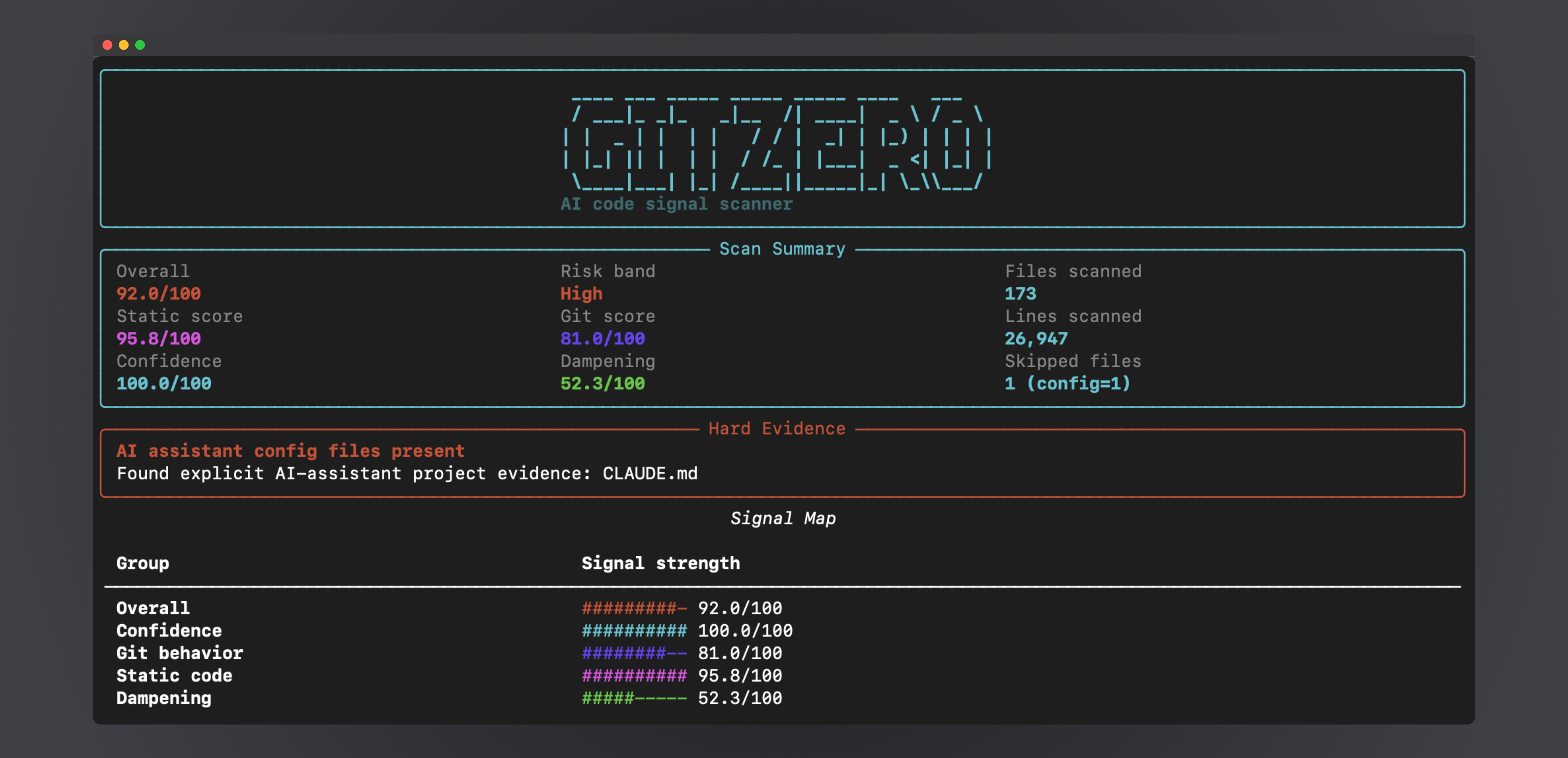
GitZero uses a hybrid detection pipeline: deterministic heuristics produce the primary explainable score, while an optional calibrated Random Forest provides a separate learned probability.
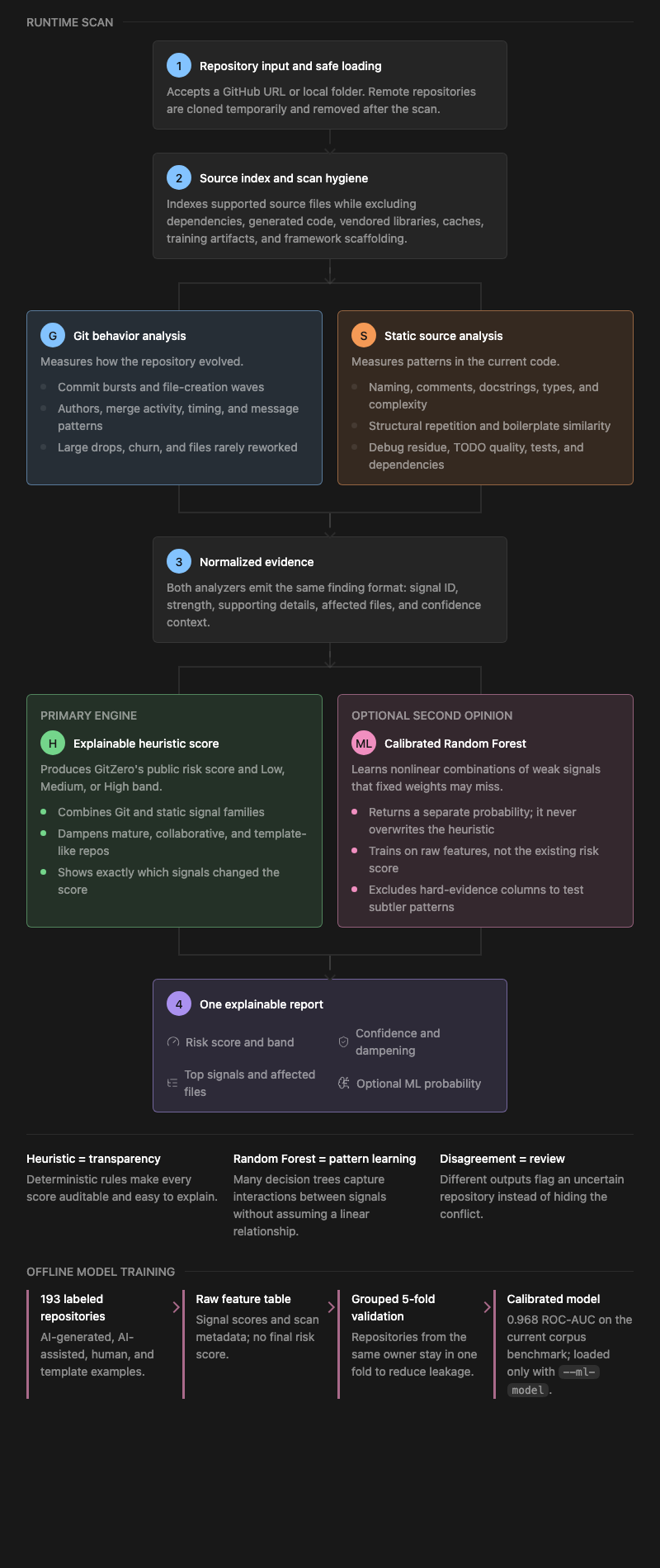
- Load and filter the repository. GitZero accepts a local folder or public GitHub URL, builds a source-file index, and excludes dependencies, generated code, vendored libraries, caches, training artifacts, and framework scaffolding.
- Analyze two evidence families. Git history analysis measures repository behavior over time, while static analysis examines patterns in the current source code.
- Normalize and score the evidence. Findings use a common signal format containing a score, supporting details, affected files, and confidence context. The heuristic combines independent signal families and applies false-positive dampeners.
- Produce an explainable report. The CLI shows the risk score, Low/Medium/High band, confidence, dampening, top signals, highest-signal files, and optional ML probability.
The Random Forest is an optional second opinion, not a replacement for the explainable heuristic. Its purpose is to learn nonlinear interactions between weak signals that fixed weights may miss.
- It trains on raw signal and scan-metadata features, not GitZero's final
risk_score. - Hard-evidence columns are excluded so the model must learn subtler repository patterns.
- Its probability is reported separately and never overwrites the heuristic result.
- A disagreement between the two methods indicates uncertainty and gives the reviewer a reason to inspect the evidence.
The current calibrated Random Forest was evaluated with owner-grouped 5-fold cross-validation on 193 labeled repositories and reached 0.968 ROC-AUC on that corpus. This is a project benchmark, not a claim of universal authorship-detection accuracy.
Git signals — large commit bursts, file creation waves, single-drop histories, no-merge linear histories, formulaic commit messages, author uniformity, tight commit time clustering.
Static signals — naming entropy, docstring density, type annotation coverage, complexity uniformity, structural repetition, debug artifact absence, generic TODOs, shallow test quality, README-to-code misalignment.
Hard evidence — explicit AI config files: AGENTS.md, CLAUDE.md, .cursorrules, .aider, Copilot instructions, and README phrases like vibe coded or built with ChatGPT.
False-positive guards — vendor libraries (jQuery, Bootstrap), framework scaffolding, multi-author history, merge commits, and long-lived organic repos all reduce the score automatically.
- 25+ detection signals with per-signal weights and confidence scoring
- Jupyter notebook support — extracts and analyzes
.ipynbcode cells - ML pipeline: Random Forest with grouped cross-validation on 193 labeled repos — 0.968 ROC-AUC without hard-evidence features (evaluation summary)
- Batch export to JSONL/CSV with ML-ready feature columns for every signal
--ml-modelflag for experimental probability alongside the heuristic score- 50+ tests, ruff clean
pip install gitzerogitzero scan https://github.com/user/repo # scan any public GitHub repo
gitzero scan ./my-local-repo --verbose # show per-file signal breakdown
gitzero scan ./my-local-repo --json # machine-readable output
gitzero batch ./corpus --recursive --label-from-parent --format jsonl -o out.jsonlStack: Python · Typer · Rich · PyDriller · radon
0 comments
log in to comment.