


A cross-platform Android + iOS game shipped end-to-end without a single hand-typed line of code.
Kotlin Multiplatform · Jetpack Compose · SwiftUI · CI · 140+ tests · ADRs. All Kotlin, Swift, Gradle, GitHub Actions, and Markdown in this repo was generated by Cursor and Claude Code under direct human prompting and review. Read the retrospective for the honest version of what worked and what didn't.
6,585 lines of Kotlin · 2,007 lines of Swift · 140+ tests across 9 suites · 5 ADRs · 30 levels · 0 lines hand-typed.


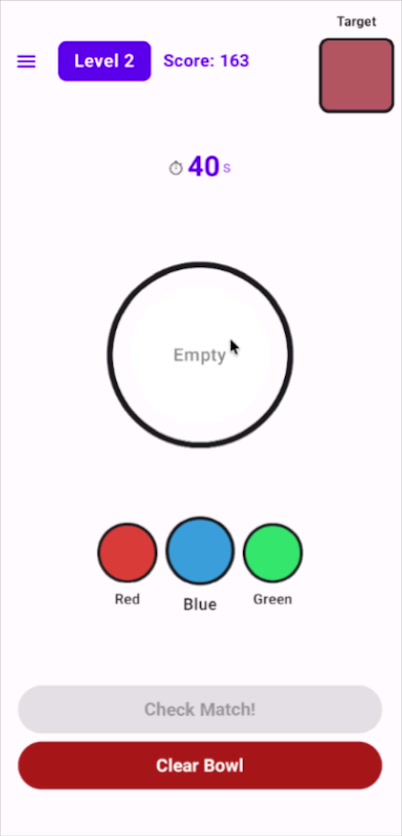
Start · Color mixing · Math challenge · Color unlocked · Leaderboard
45-second highlight — color mixing, math gates, tier unlocks, and the end-game celebration:
For the full 3:33 walkthrough, click the poster:
23 MB MP4 · also on the release page
| If you have… | Read this |
|---|---|
| 2 minutes | This section + Why this exists + Notable engineering decisions |
| 10 minutes | Above + RETROSPECTIVE.md (AI-build story) + ARCHITECTURE.md (technical depth) |
| 30 minutes | Above + docs/adr/ (decision records) + docs/dev-notes/ (curated AI-generated build journal) + the source |
| You're hiring | Skip to Notable engineering decisions and What this proves out |
The premise: find out whether a non-trivial cross-platform mobile app — KMP, Compose, SwiftUI, CI, tests, release pipeline — is buildable end-to-end with AI today, and where the seams are.
The answer is documented in RETROSPECTIVE.md. Short version: yes, with caveats. AI is excellent at boilerplate, cross-platform consistency, and KMP migration mechanics. It needs deliberate human direction on thread safety, scope, and the last 20% of any feature with subjective quality (animation, distractor design).
| Metric | Value |
|---|---|
| Lines of Kotlin (total) | 6,585 |
| Lines of Swift (iOS UI) | 2,007 |
| Source files | 69 (52 Kotlin, 17 Swift) |
Shared module (commonMain) |
~1,000 LOC of game logic |
| Unit tests | 140+ across 8 JVM suites + 11 Paparazzi snapshot tests |
| Levels | 30 |
| Unlockable color tiers | 6 |
| Min Android SDK | 24 (Android 7.0+) |
| Target Android SDK | 35 |
| Min iOS | 15.0 |
These are the calls that say the most about how the project was built. Each links to a deeper artifact.
-
Atomic state updates (ADR-0002). Every mutation in
GameControlleris_gameState.update { state -> state.copy(...) }, never_gameState.value = ...copy(...). The latter is a non-atomic read-modify-write — the timer-tick coroutine and UI thread can race and silently lose updates. The first AI cut had this bug everywhere; conversion required a deliberate sweep. -
iOS observation: 100ms polling, not SKIE (ADR-0003). Bridging Kotlin
StateFlowto SwiftUI cleanly requires SKIE or KMP-NativeCoroutines, both of which add significant Gradle and compiler-plugin complexity. For a turn-based game,Timer.publish(every: 0.1)pollinggameController.gameState.valueis well below the perception threshold and adds zero dependencies. The trade-off is the documented choice. -
Particle animation: direct
DrawScope, not Compose recomposition (ADR-0004). The 10-second end-game celebration with 50+ particles dropped frames when each particle had its ownanimateFloatAsState. Current implementation uses a single masterAnimatableclock, computing positions insideCanvas { }'sDrawScopefrom pre-allocatedFloatArraybuffers. Zero per-frame allocations, zero recomposition. -
Math distractors: 6 strategies, not random. Naive random wrong answers are easy for a kid to eliminate.
MathQuestionGeneratorproduces near-misses, off-by-one factor errors, squared-factor traps, nearby multiples — patterns that mirror real arithmetic mistakes. A 9-year-old has to actually compute6 × 7. Took several prompt cycles to nail. -
Tier-based color unlocks with random selection. Six unlock tiers; one color per tier is chosen at game start from a candidate pool. Two playthroughs at the same difficulty have different palettes — replay value with no extra content.
- A non-trivial cross-platform mobile app (KMP + Compose + SwiftUI) is buildable end-to-end with AI tooling.
- AI handles cross-platform consistency well — game logic stayed in sync across Android and iOS without manual coordination, which is a real, repeatable benefit of single-AI-author KMP work.
- AI-generated code still benefits from a deliberate human-led review pass: dead code removal, thread-safety fixes, and architecture refinement required focused cleanup commits. That's documented.
The full retrospective is in RETROSPECTIVE.md. Example prompts you could use to reproduce parts of this project are in docs/reproduce.md. Curated AI-generated dev notes from the build are in docs/dev-notes/.
graph TB
  subgraph Shared["shared/ — Kotlin Multiplatform"]
    direction TB
    GC[GameController]
    GS[GameState · StateFlow]
    CM[ColorMixer]
    LM[LevelManager]
    MQG[MathQuestionGenerator]
    LB[LeaderboardManager]
    EX["expect: Haptics · Storage · Sound"]
  end

  subgraph Android["app/ — Android · Jetpack Compose"]
    direction TB
    AVM[GameViewModel]
    AC[Compose UI]
    AVM -->|delegates| GC
    AC -->|observes| AVM
  end

  subgraph iOS["iosApp/ — iOS · SwiftUI"]
    direction TB
    IVM["GameViewModel<br/>(100ms StateFlow polling)"]
    SU[SwiftUI Views]
    IVM -->|delegates| GC
    SU -->|observes| IVM
  end

  EX -.actual.-> Android
  EX -.actual.-> iOS
GameController is the single source of truth. Every action — adding a drop, checking a match, ticking the timer — funnels through it and is committed via atomic StateFlow.update { }. Both platforms observe the same StateFlow<GameState>. See ARCHITECTURE.md for the full breakdown.
- 30 progressive levels with target recipes growing from 2 colors to 5
- Math challenges gating new color tiers (multiplication with pedagogically plausible distractors)
- Three difficulty modes with timed gameplay on Medium/Hard
- Local leaderboard with Today, This Week, This Month, All Time tabs
- Multi-phase completion celebration with 50+ particles
- Adaptive layouts for portrait, landscape, phones, and (Android) tablets
- Haptic feedback at key interactions and on timer warnings
- Fully offline — no network calls, no analytics SDK, no tracking. Verifiable from the manifest.
ColorMixLab/
├── app/                              # Android application
│   └── src/
│       ├── main/java/com/colormixlab/
│       │   ├── MainActivity.kt       # Sealed Screen routing
│       │   ├── game/                 # ViewModel
│       │   ├── ui/                   # Compose screens & dialogs
│       │   └── utils/                # Haptics, color extensions
│       └── test/                     # 100+ unit tests
├── shared/                           # Kotlin Multiplatform shared module
│   └── src/
│       ├── commonMain/               # GameController, GameState, ColorMixer, ...
│       ├── androidMain/              # Android actuals (SharedPreferences, etc.)
│       └── iosMain/                  # iOS actuals (NSUserDefaults, etc.)
├── iosApp/ColorMixLab/               # iOS Xcode project
├── docs/
│   ├── adr/                          # Architecture Decision Records
│   ├── reproduce.md                  # Example prompts to rebuild this project
│   └── dev-notes/                    # Curated AI-generated build journal
└── .github/workflows/                # CI: build+test, CodeQL, release
| Levels | Available colors | Unlocked at |
|---|---|---|
| 1-3 | Red, Blue, Green | Start |
| 4-6 | + 1 from {Yellow, Cyan, Gray} | Level 4 (after math challenge) |
| 7-9 | + 1 from {Orange, Magenta, Coral} | Level 7 (after math challenge) |
| 10-12 | + 1 from {Purple, Lime, Turquoise} | Level 10 (after math challenge) |
| 13-15 | + 1 from {Pink, Teal} | Level 13 (after math challenge) |
| 16-18 | + 1 from tier 5 | Level 16 (after math challenge) |
| 19-30 | + 1 from tier 6 | Level 19 (after math challenge) |
| Mode | Per-level timer | Math timer | Score multiplier |
|---|---|---|---|
| Easy | None | None | 0.75x |
| Medium | 40s | 20s | 1.0x |
| Hard | 20s | 10s | 1.25x |
- Match accuracy gates the level (≥80%); higher accuracy yields proportionally more points (40 → 150 base)
- Difficulty multiplier applied: Easy 0.75x, Medium 1.0x, Hard 1.25x
- Time bonus on Medium/Hard scales linearly with remaining seconds (up to 50 points)
- Wrong math answer: −75 points
- Android: Android Studio (2023.1+), JDK 17+, Android SDK 35
- iOS: Xcode 15+, macOS
./gradlew build              # Build everything
./gradlew test               # Run unit tests
./gradlew installDebug       # Install on connected device
./gradlew detekt             # Static analysis
./gradlew spotlessCheck      # Formatting check
./gradlew spotlessApply      # Auto-fix formatting
./gradlew koverHtmlReport # Coverage report → build/reports/kover/html/- Build the shared KMP framework:
./gradlew :shared:linkDebugFrameworkIosSimulatorArm64
- Open
iosApp/ColorMixLab/ColorMixLab.xcodeprojin Xcode - Build and run on simulator or device
./gradlew test                          # All unit tests
./gradlew :app:verifyPaparazziDebug     # Compose snapshot tests
./gradlew :app:recordPaparazziDebug     # Re-record snapshot goldens
100+ JUnit tests over the shared game logic, run via the Android test runner. Compose snapshot tests via Paparazzi catch visual regressions in MixingBowl, ColorButton, TargetColor, MathAnswerButton, and ResultDialogContent. See docs/snapshot-tests.md.
Suite breakdown:
- GameController — game flow, scoring, timer, math challenges (27 tests)
- LeaderboardManager — CRUD, ranking edge cases, time-window queries, capacity, corruption recovery (15 tests)
- ColorMixer — averaging, similarity, weighting (15 tests)
- LevelManager — target generation, complexity scaling, variety (18 tests)
- MathQuestionGenerator — question structure, distractor quality, difficulty scaling (17 tests)
- GameState, LeaderboardEntry, MathChallengeTimer — defaults, sorting, serialization, configuration (48 tests)
- SnapshotTests — Paparazzi visual regression on
MixingBowl,ColorButton,TargetColor,MathAnswerButton,ResultDialogContent(11 snapshots)
ROADMAP.md lays out deliberate v1 scope decisions and acknowledged trade-offs (silent sound effects, no iOS test target, R8 not enabled, etc.). Read it before assuming a missing feature is an oversight.
Why a color-mixing game? Constrained problem with rich UX surface — color science, kid-friendly UX, animation, math pedagogy, persistence, KMP — without being so big that AI generation breaks down. A solid stress test for AI-driven mobile development.
Why kids 7–11? Forces accessibility-first design: large tap targets, immediate feedback, no text-heavy UI, gentle failure states.
Why KMP and not Flutter / React Native? Native UI on both platforms (Compose + SwiftUI) with shared logic, not a shared rendering layer. KMP is the right tool when you care about platform feel and want to leverage each platform's animation primitives.
Did Claude actually write 100% of the code? Yes. I prompted, reviewed, and decided; Claude generated. See RETROSPECTIVE.md for the retrospective and docs/reproduce.md for example prompts.
Will you accept PRs? Yes — see CONTRIBUTING.md. Bug fixes and small enhancements welcome. PRs themselves do not need to be AI-generated.
- Star the repo if you want to follow along
- Read RETROSPECTIVE.md for the AI-development retrospective
- Read ARCHITECTURE.md for the architecture deep-dive
- Open an issue with feedback or bugs
MIT — see LICENSE.
0 comments
log in to comment.