

Julia 1.13's REPL now performs syntax highlighting, and lets you customise it. This is really cool!
What could be even cooler? Well, loading your existing colorscheme from your favourite editor, which is of course Neovim! (emacs heathens begone)
This package lets you do just that. Note that this is mostly vibe-coded with Fable 5.1. (But this README is written by hand!)
Install with:
] app dev https://github.com/penelopeysm/NvimToREPLColor.jlThen run this from your shell with:
nvim2juliareplIt will run Neovim to find out what colour each highlight group is set to in your configuration, and generate the appropriate TOML file so that you can use it in your REPL.
You can use nvim2juliarepl -h to see all options.
Neovim, especially with tree-sitter installed, has many more syntax highlighting groups than Julia's REPL. For example, tree-sitter will define extra syntax groups for things like built-in types, etc., but there is no way to identify and highlight these specifically in the REPL. So this is really a best-effort attempt to reproduce your colorscheme. It won't be perfect. However, it should be good enough for a first pass. You can always tweak the generated TOML yourself if you want. Improvements to this are very welcome!
Oh, there's one more bit of opinionated input that I inserted into the generated TOML. I got rid of the default solid-red background for errors, since it makes code quite hard to read. It's replaced with a red underline.
In the screenshot below, the left side is my Neovim, and the right side is the Julia REPL.
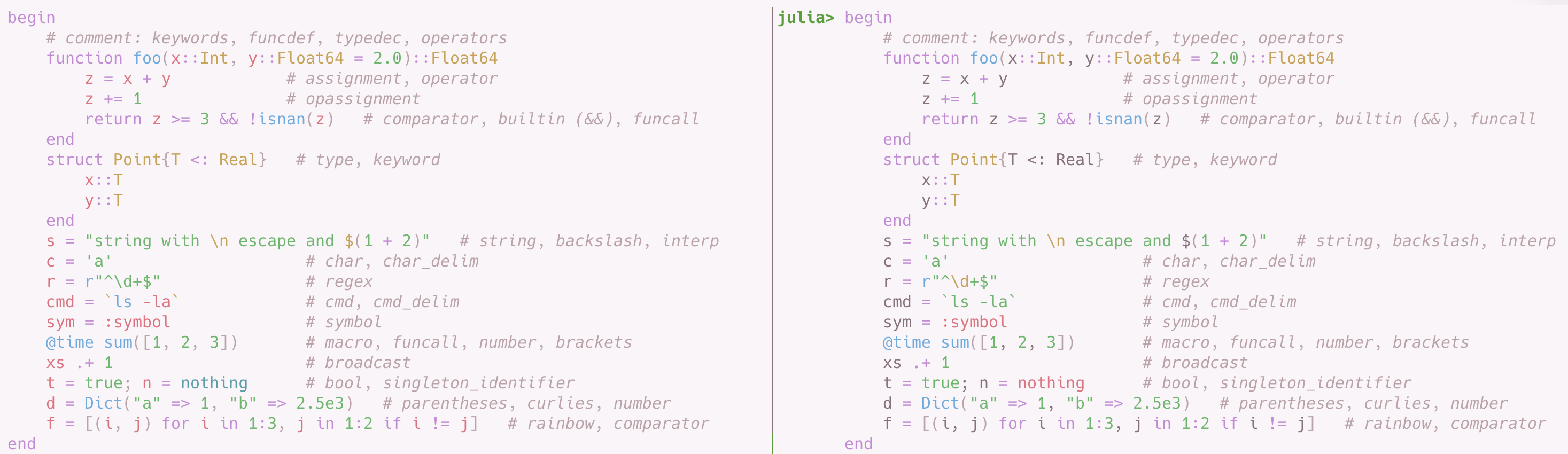
(If you're wondering what my colorscheme is, it's mostly Edge with some personal modifications that I like.)
And here is an example of Catppuccin Latte:
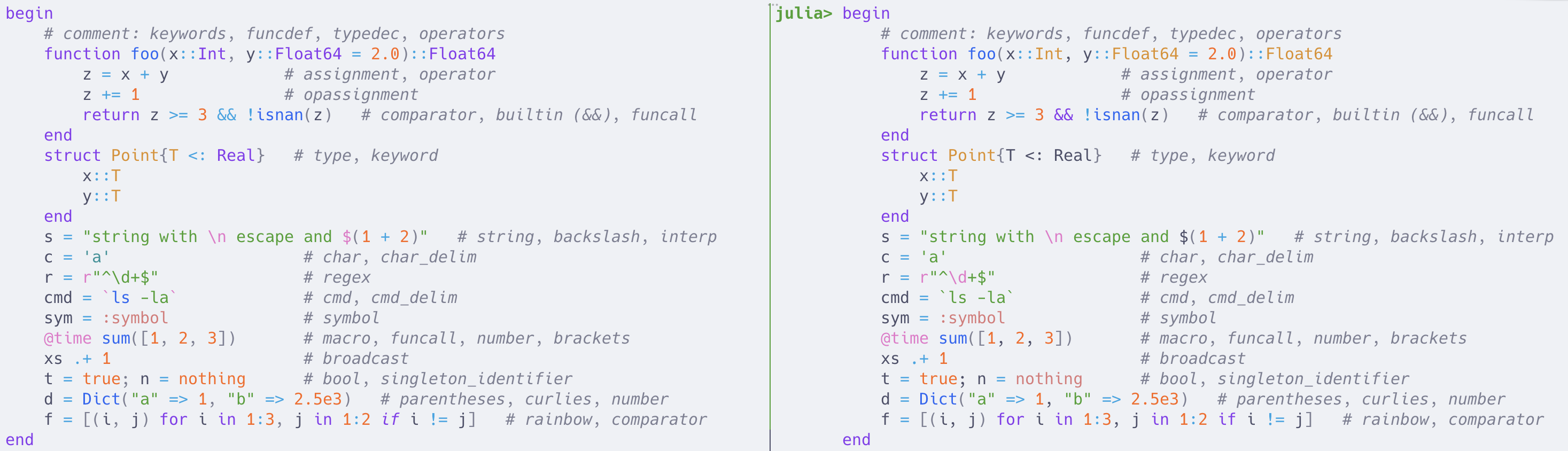
Here is the code in the example if you want to use it for your own side-by-side comparison:
begin
    # comment: keywords, funcdef, typedec, operators
    function foo(x::Int, y::Float64 = 2.0)::Float64
        z = x + y            # assignment, operator
        z += 1               # opassignment
        return z >= 3 && !isnan(z)   # comparator, builtin (&&), funcall
    end
    struct Point{T <: Real}   # type, keyword
        x::T
        y::T
    end
    s = "string with \n escape and $(1 + 2)"   # string, backslash, interp
    c = 'a'                    # char, char_delim
    r = r"^\d+$"               # regex
    cmd = `ls -la`             # cmd, cmd_delim
    sym = :symbol              # symbol
    @time sum([1, 2, 3])       # macro, funcall, number, brackets
    xs .+ 1                    # broadcast
    t = true; n = nothing      # bool, singleton_identifier
    d = Dict("a" => 1, "b" => 2.5e3)   # parentheses, curlies, number
    f = [(i, j) for i in 1:3, j in 1:2 if i != j]   # rainbow, comparator
end
0 comments
log in to comment.